



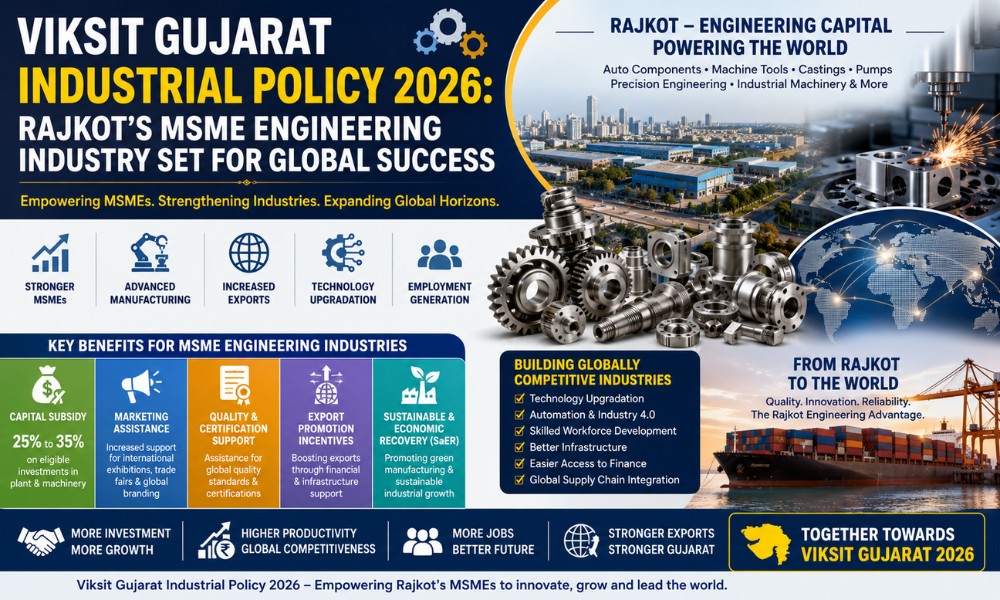
The Government of Gujarat has introduced the Viksit Gujarat Industrial Policy 2026 with a strong vision to transform the state into a global manufacturing and industrial powerhouse. Among the biggest beneficiaries of this policy is Rajkot, a city widely recognized as the engineering capital of Gujarat. Home to thousands of MSMEs, auto component manufacturers, foundries, machine tool producers, and precision engineering units, Rajkot is expected to witness a new phase of industrial growth, technology adoption, and global market expansion.
The new industrial policy is designed to encourage innovation, improve competitiveness, increase exports, and generate employment while providing financial assistance to industries investing in modernization. For Rajkot’s engineering ecosystem, this policy could become a turning point in achieving international recognition.
Rajkot – Gujarat’s Engineering Hub
Rajkot has earned a reputation for manufacturing high-quality engineering products including:
- Auto components
- Diesel engines
- Machine tools
- Casting and forging products
- CNC machinery
- Agricultural equipment
- Industrial pumps
- Precision engineering components
Thousands of MSMEs form the backbone of Rajkot’s economy. These businesses not only supply products across India but also export engineering goods to countries in Europe, Africa, the Middle East, and Asia. However, increasing global competition requires continuous technological upgrades, automation, and quality improvements. The Viksit Gujarat Industrial Policy 2026 directly addresses these challenges.
Key Objectives of Viksit Gujarat Industrial Policy 2026
The policy focuses on creating an industrial ecosystem that encourages sustainable development and long-term competitiveness. Its major objectives include:
- Strengthening MSMEs
- Promoting advanced manufacturing
- Increasing exports
- Supporting technology upgrades
- Encouraging automation and digital transformation
- Attracting global investments
- Creating employment opportunities
- Building globally competitive industries
These initiatives are expected to help Gujarat maintain its position as one of India’s leading industrial states.
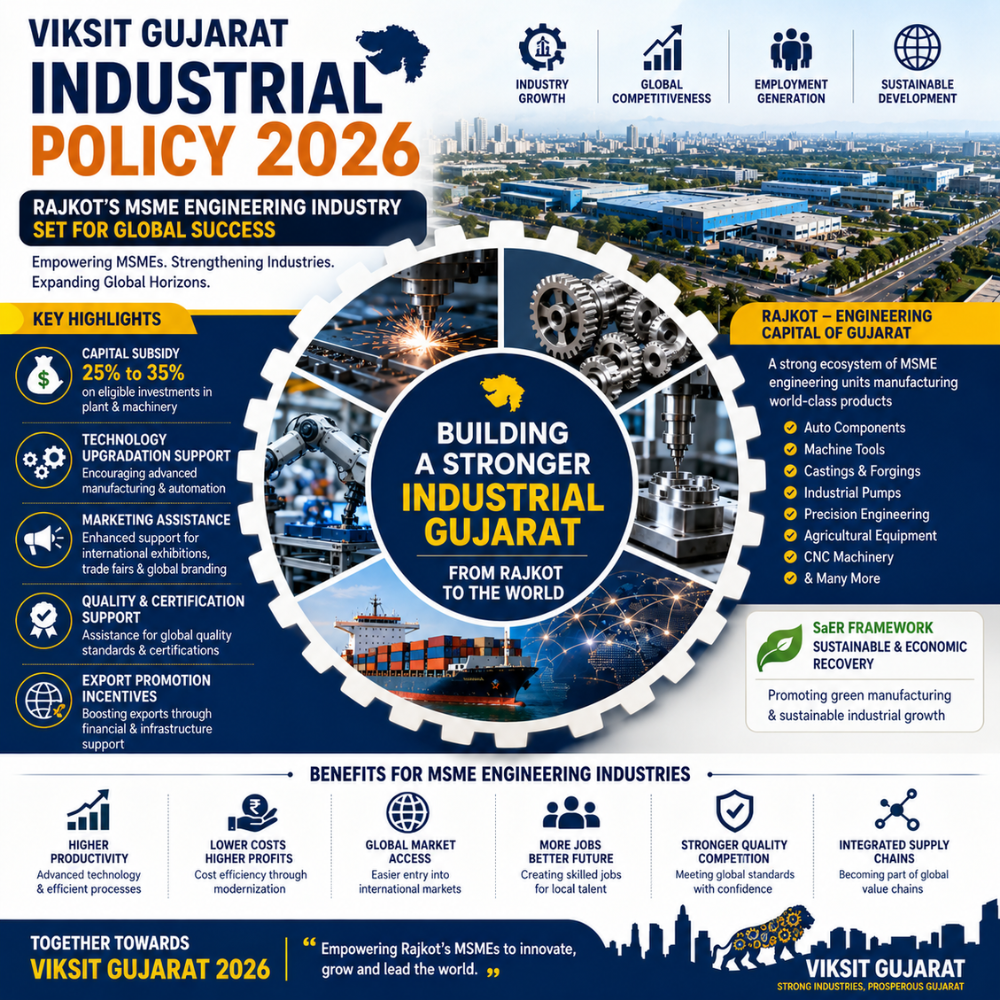
Major Benefits of Viksit Gujarat Industrial Policy 2026 for MSMEs
Micro, Small and Medium Enterprises (MSMEs) are among the biggest beneficiaries of the new policy.
The government plans to provide financial incentives that help industries modernize machinery, improve productivity, and reduce operational costs.
Some of the key benefits include:
- Capital investment subsidies
- Interest subsidies
- Technology upgradation support
- Assistance for quality certification
- Export promotion incentives
- Infrastructure development support
- Skill development programs
These incentives reduce the financial burden on businesses while encouraging investment in modern manufacturing technologies.
Capital Subsidy for Industrial Modernization
One of the most attractive features of the policy is enhanced capital subsidy.
Engineering industries planning to purchase:
- CNC machines
- Robotics
- Automation systems
- Precision manufacturing equipment
- Digital production technologies
can receive financial assistance from the government.
Reports indicate that eligible MSMEs may receive capital subsidies ranging between 25% and 35%, depending on investment category and eligibility criteria. This significantly lowers the cost of adopting advanced manufacturing technologies.
For Rajkot’s engineering sector, where modernization is essential for competing globally, these subsidies could accelerate industrial transformation.
Increased Support for Marketing and International Expansion
The policy also emphasizes market expansion.
Many small manufacturers in Rajkot produce high-quality engineering products but struggle with branding, international marketing, and participation in overseas trade fairs.
To address this challenge, the policy proposes increased assistance for:
- International exhibitions
- Trade fairs
- Buyer-seller meets
- Export promotion activities
- Global branding initiatives
Marketing assistance limits have reportedly been increased, enabling MSMEs to showcase their products in international markets and build stronger export networks.
Global Supply Chain Opportunities
International manufacturers increasingly seek reliable suppliers from India.
Rajkot’s engineering industries already manufacture components for:
- Automotive companies
- Agricultural equipment manufacturers
- Industrial machinery producers
- Pump manufacturers
- Heavy engineering companies
With improved infrastructure, better quality standards, and government incentives, local MSMEs can become preferred suppliers in global supply chains.
The policy aims to make Gujarat industries more competitive against manufacturers from countries such as China, Vietnam, and other emerging industrial economies.
Sustainable and Economic Recovery (SaER) Framework
An important aspect highlighted in the policy is the SaER (Sustainable and Economic Recovery) framework.
The objective is to encourage industries to adopt:
- Energy-efficient manufacturing
- Sustainable production methods
- Resource optimization
- Green industrial practices
- Environment-friendly technologies
Global buyers increasingly prefer suppliers following sustainability standards. Rajkot industries adopting these practices can improve export opportunities while reducing production costs over the long term.
Technology Upgradation for Engineering Industries
Technology is rapidly changing the manufacturing landscape.
Modern engineering industries now depend on:
- Artificial Intelligence
- Automation
- Robotics
- IoT-enabled manufacturing
- Smart factories
- Predictive maintenance
- Digital quality control
The Viksit Gujarat Industrial Policy 2026 encourages industries to invest in these technologies through financial support and incentives.
This will help Rajkot manufacturers improve:
- Product quality
- Manufacturing accuracy
- Production speed
- Cost efficiency
- Customer satisfaction
Employment Generation
Industrial expansion naturally creates employment.
As engineering companies expand operations, there will be growing demand for:
- Mechanical engineers
- Production engineers
- CNC operators
- Quality inspectors
- Automation specialists
- Skilled technicians
- Industrial designers
- Machine operators
This will create new opportunities for local youth while strengthening Gujarat’s industrial workforce.
Boost for Auto Parts Industry
Rajkot is one of India’s major auto component manufacturing clusters.
The city manufactures:
- Engine components
- Brake parts
- Gear components
- Castings
- Bearings
- Precision machined parts
The industrial policy’s focus on modernization and export promotion is expected to strengthen the auto parts sector significantly.
Manufacturers will be better positioned to meet international quality standards and secure contracts with global automotive brands.
Strengthening Export Potential
Exports remain a major growth driver for engineering industries.
The new policy supports exporters through:
- Market development assistance
- International certification support
- Export infrastructure
- Participation in overseas exhibitions
- Logistics improvements
These initiatives help MSMEs reach international buyers more effectively while reducing export-related costs.
Digital Manufacturing and Industry 4.0
Industry 4.0 technologies are transforming global manufacturing.
The policy encourages adoption of:
- Smart manufacturing
- Digital monitoring systems
- Cloud-based production management
- Automated inspection
- Data analytics
- Industrial software integration
Rajkot industries embracing Industry 4.0 will become more productive and globally competitive.
Why This Policy Matters for Rajkot
Rajkot has always been known for entrepreneurial spirit and engineering excellence.
However, today’s global manufacturing environment demands:
- Better technology
- Higher productivity
- Sustainable operations
- International certifications
- Faster production
- Competitive pricing
The Viksit Gujarat Industrial Policy 2026 provides financial support and strategic direction to help local industries achieve these goals.
For thousands of MSMEs, this policy represents an opportunity to modernize operations, increase exports, attract new customers, and build globally recognized brands.
Challenges That Industries Must Address
While the policy offers significant opportunities, industries must also focus on:
- Continuous skill development
- Research and innovation
- Quality management systems
- Digital transformation
- Compliance with international standards
- Sustainable manufacturing
Government incentives can support these initiatives, but long-term success will depend on how effectively businesses implement modernization strategies.
Conclusion
The Viksit Gujarat Industrial Policy 2026 marks a significant step toward making Gujarat a global industrial leader. For Rajkot’s MSME engineering sector, the policy offers a powerful combination of financial incentives, technology support, export promotion, sustainability initiatives, and infrastructure development.
With enhanced capital subsidies, marketing assistance, encouragement for Industry 4.0 adoption, and stronger global connectivity, Rajkot’s engineering industries have an excellent opportunity to expand beyond domestic markets and establish themselves as trusted global manufacturing partners.
If implemented effectively, the policy will not only strengthen the competitiveness of Rajkot’s engineering ecosystem but also generate employment, boost exports, encourage innovation, and contribute substantially to Gujarat’s vision of becoming a world-class industrial economy under the Viksit Gujarat 2026 initiative.