





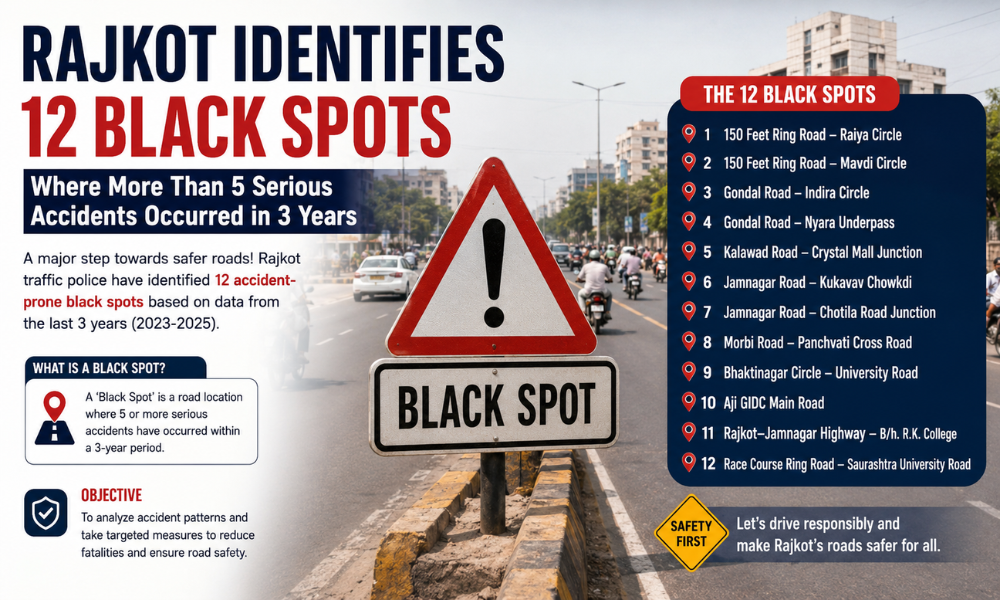
Rajkot has identified 12 major black spots across the city and surrounding areas where more than five serious road accidents have occurred during the past three years. The identification of these accident-prone locations is part of an ongoing road safety initiative aimed at reducing serious and fatal accidents and improving traffic management across Rajkot.
According to the details reported in the newspaper clipping, authorities are reviewing accident-prone locations under the city’s road safety mechanism. The exercise focuses on locations where repeated serious accidents have taken place and where immediate safety improvements may be required. Among the identified locations, the Kuvadva and Aji Dam areas have emerged as particularly important points of concern.
12 Major Black Spots Identified in Rajkot
The list includes important roads, junctions, cuts and industrial areas that experience significant traffic movement. The 12 identified black spots are:
- Gondal Road, opposite Tata Showroom
- Gondal Road Chowkdi
- Near Khokhaddad Bridge
- Aji Dam Chowkdi
- Near the Khataras Stand at Market Yard
- Navagam Road Cut
- Anandpar Road Cut
- Cut near Tramba Village
- Cut near Maliyasan Road
- Madhapar Chowkdi
- Greenland Chowkdi
- Kuvadva GIDC
These locations have been identified because of the number and severity of accidents reported over a three-year period. Such black spots generally require special attention because factors such as heavy traffic, road intersections, turning movements, inadequate visibility, speeding, road design and high vehicle movement can increase the possibility of serious crashes.
Kuvadva and Aji Dam Areas Among the Key Concern Zones
The newspaper report highlights that Kuvadva and the Aji Dam Police Station areas have a comparatively higher concentration of black spots. Both areas connect important routes and experience regular movement of passenger vehicles, commercial vehicles and heavy traffic.
Kuvadva has become an important transportation and industrial corridor around Rajkot. The presence of Kuvadva GIDC and surrounding roads contributes to regular movement of trucks, goods vehicles and other commercial traffic. Such mixed traffic can create additional safety challenges, particularly at road cuts, junctions and busy connecting roads.
The Aji Dam area is another important traffic zone. Aji Dam Chowkdi and nearby roads serve as connecting routes for people travelling between different parts of Rajkot and surrounding areas. The combination of local traffic and vehicles travelling through the area makes road safety measures particularly important.
Previous List Had 18 Black Spots
The report also states that Rajkot previously had 18 identified black spots. Of these, six locations have been removed from the black-spot list following the review. The authorities have now identified the 12 locations where serious accident patterns continue to require attention.
The process of identifying and removing black spots is important because road conditions and traffic patterns can change over time. Improvements such as road engineering work, better signage, traffic control, lighting, junction modifications or other safety interventions can potentially reduce accidents at previously dangerous locations.
At the same time, new accident-prone locations can emerge as traffic volumes increase or road networks develop. This makes regular monitoring essential for maintaining road safety.
Three New Black Spots Proposed
Along with the 12 existing black spots, authorities have also proposed adding three new locations to the black-spot list. According to the newspaper report, a proposal has been sent to the Commissioner of the Gujarat Road Safety Authority for consideration.
The three proposed locations are:
- Gavridhar Road, under the Kuvadva Police Station area
- Ayodhya Chowk, under the Gandhigram Police Station area
- The area near the bridge at Dhabka, under the Aji Dam Police Station area
The proposal indicates that authorities are continuing to monitor accident patterns rather than relying only on previously identified locations. If approved, these locations could receive additional attention under road safety planning.
Joint Road Safety Review
The identification of black spots is not limited to a single department. The newspaper report mentions that the decision is being undertaken through a joint committee involving agencies such as the RTO, City Police, NHAI, Roads and Buildings Department, and Rajkot Municipal Corporation.
Coordination between these departments is important because road accidents can involve multiple factors. Traffic enforcement may be required at some locations, while others may need engineering changes, improved road markings, better lighting, signage or changes to road design.
The RTO and traffic police can focus on enforcement, vehicle movement and driver behaviour. The NHAI and Roads and Buildings Department can examine road infrastructure and engineering-related concerns, while the Rajkot Municipal Corporation can address issues related to city roads, junctions, lighting and other civic infrastructure.
Why Black Spot Identification Matters
A black spot is generally considered a location where a relatively high number of serious road accidents occur. Identifying such places helps authorities concentrate resources on locations where road safety interventions may have the greatest impact.
The 12 locations identified in Rajkot include major chowkidis, road cuts, bridge areas and industrial zones. These are places where vehicles may change direction, merge into traffic, cross roads or interact with vehicles travelling at different speeds.
Improving safety at such locations can involve several measures. These may include clearer road signs, improved lane markings, speed-control measures, better street lighting, pedestrian safety arrangements, junction redesign, traffic signals and increased enforcement.
However, the appropriate solution depends on the individual characteristics of each location. A busy road junction may require different measures from an accident-prone bridge approach or an industrial-area road.
Focus on Preventing Serious and Fatal Accidents
The primary objective of the black-spot review is to reduce serious accidents and save lives. Repeated accidents at the same location can indicate that drivers alone may not be responsible and that the road environment itself may require examination.
For Rajkot, identifying these 12 locations provides an opportunity to study accident patterns and introduce targeted safety improvements. Regular monitoring can also help authorities determine whether the measures introduced at a particular black spot are producing results.
The removal of six locations from the earlier list of 18 black spots also demonstrates the importance of periodic assessment. At the same time, the proposal to add three new locations shows that road safety planning needs to remain dynamic as traffic conditions change.
Road Users Also Have an Important Role
While infrastructure and enforcement are essential, road users also play a major role in reducing accidents. Drivers should follow speed limits, avoid dangerous overtaking, use indicators while turning, maintain safe distances and remain particularly cautious near junctions, road cuts and bridges.
Two-wheeler riders should use helmets, while car occupants should wear seat belts. Heavy-vehicle drivers should exercise additional caution in areas with mixed traffic and high pedestrian or two-wheeler movement.
Extra caution is especially important at the 12 identified black spots because these locations have already recorded repeated serious accidents.
Looking Ahead for Rajkot Road Safety
The identification of 12 black spots represents another step toward improving road safety in Rajkot. With six locations removed from the previous list and three additional locations proposed, authorities are continuing to reassess accident-prone areas based on available accident data.
The involvement of multiple departments can help bring together traffic enforcement, road engineering and civic infrastructure improvements. If targeted measures are implemented effectively and monitored regularly, they could help reduce the frequency and severity of accidents at these locations.
For a rapidly developing city such as Rajkot, road safety will remain an important priority as vehicle numbers and traffic movement continue to increase. Identifying dangerous locations early, improving infrastructure and encouraging responsible driving can collectively contribute to safer roads.
Conclusion
Rajkot has identified 12 black spots where more than five serious accidents occurred within three years, bringing renewed attention to some of the city’s most accident-prone roads and junctions. Kuvadva and Aji Dam areas are among the key zones highlighted in the review. With six locations removed from the previous list of 18 and three new locations proposed, authorities are continuing their efforts to identify and address serious road safety concerns.
The coordinated efforts of the RTO, traffic police, NHAI, Roads and Buildings Department and Rajkot Municipal Corporation, combined with responsible behaviour from road users, can play a crucial role in making Rajkot’s roads safer and reducing serious road accidents.