





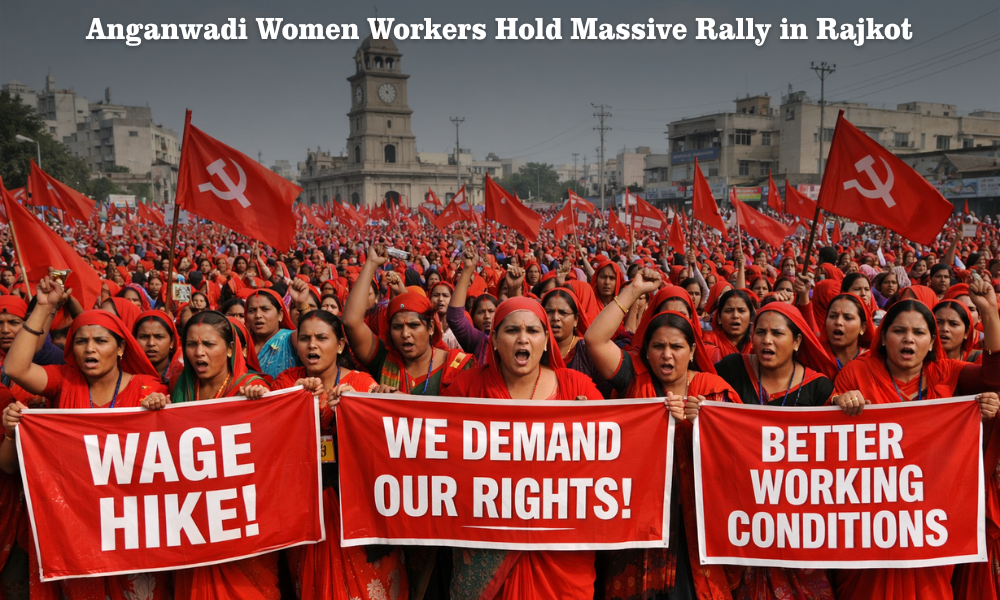
In a powerful display of unity and determination, hundreds of Anganwadi women workers from across the Saurashtra region gathered in Rajkot to voice their long-pending demands. Carrying placards, banners, and slogans, the women staged a large rally and submitted representations to district authorities, seeking an increase in wages, improved facilities, and better support systems to perform their duties effectively. The rally once again highlighted the critical yet often overlooked role Anganwadi workers play in India’s public health and child development framework.
Anganwadi workers are the backbone of the Integrated Child Development Services (ICDS) scheme, which focuses on nutrition, healthcare, early childhood education, and maternal welfare. Despite their essential contribution, these workers—most of whom are women from economically modest backgrounds—have long complained of inadequate remuneration and insufficient resources. The Rajkot rally reflected years of accumulated frustration and unmet promises.
A United Voice from Saurashtra
Women Anganwadi workers traveled to Rajkot from various districts of Saurashtra to participate in the protest. The scale of the gathering itself sent a strong message to the administration. Many participants stated that while their responsibilities have increased significantly over the years, their wages have not kept pace with rising inflation and workload.
The rally was organized under the banner of workers’ unions and associations, which have been repeatedly raising these issues with the state and central governments. Leaders addressing the gathering emphasized that Anganwadi workers are no longer limited to basic childcare tasks. Today, they are also responsible for maintaining digital records, implementing nutrition schemes, conducting surveys, and supporting multiple government programs at the grassroots level.
Demand for Wage Hike and Job Security
One of the primary demands raised during the rally was a substantial increase in monthly honorarium. Anganwadi workers argued that the current wages are insufficient to support their families, especially in the face of rising costs of living. Many pointed out that despite years of service, they are still considered “honorary workers” rather than regular government employees, which deprives them of job security, pensions, and other benefits.
Protesters demanded that their services be formally recognized as government employment, with fixed pay scales, retirement benefits, and social security provisions. According to union representatives, repeated assurances have been given in the past, but little has changed on the ground.
Call for Better Facilities and Infrastructure
Apart from wages, the rally strongly emphasized the need for better working conditions. Many Anganwadi centers operate in cramped spaces with inadequate infrastructure, lack of clean drinking water, insufficient sanitation facilities, and poor storage for nutrition supplies. Workers highlighted that such conditions not only affect their work but also put children and pregnant women at risk.
Another major concern raised was the lack of proper equipment and materials. With the increasing push toward digital reporting and online data entry, Anganwadi workers are expected to use smartphones and digital tools. However, many workers have not been provided with official devices or proper training. As a result, they often use their personal phones and spend their own money on internet data, which adds to their financial burden.
Digital Workload Without Digital Support
In recent years, digitization has become a major part of Anganwadi operations. Workers are required to upload real-time data related to nutrition distribution, attendance, health check-ups, and surveys. While the intention behind digitization is efficiency and transparency, the implementation has been challenging at the ground level.
During the Rajkot rally, several workers demanded that the government provide official mobile devices, reliable internet connectivity, and technical training. They stressed that without these facilities, digital work becomes stressful and time-consuming, especially for workers who are not familiar with advanced technology.
Rising Responsibilities, Stagnant Benefits
Anganwadi workers also highlighted how their responsibilities have expanded far beyond their original job descriptions. In addition to childcare and nutrition, they are often involved in election duties, health campaigns, census work, and emergency responses. Despite this, there has been no proportional increase in compensation or support.
Speakers at the rally noted that the COVID-19 pandemic further exposed the vulnerability of Anganwadi workers. During the crisis, they played a crucial role in community awareness, nutrition distribution, and health monitoring, often at personal risk. Yet, many feel that their contribution during such critical times has not been adequately acknowledged or rewarded.
Submission of Memorandum to Authorities
At the conclusion of the rally, representatives of the Anganwadi workers submitted a memorandum to district officials. The memorandum outlined key demands, including wage revision, regularization of services, provision of digital equipment, improved infrastructure at Anganwadi centers, and timely payment of honorariums.
Officials reportedly assured the delegation that their demands would be forwarded to higher authorities for consideration. However, workers expressed cautious optimism, stating that similar assurances in the past have not always translated into concrete action.
A Broader Issue Beyond Rajkot
While the rally took place in Rajkot, the issues raised resonate with Anganwadi workers across Gujarat and India. Similar protests and demands have been seen in various states, indicating a nationwide concern about the treatment and recognition of frontline women workers.
Social activists and labor experts argue that improving the working conditions of Anganwadi workers is not just a matter of fairness but also crucial for the success of public welfare programs. When workers are adequately paid, trained, and supported, the quality of services delivered to children and mothers improves significantly.
Conclusion
The massive rally by Anganwadi women workers in Rajkot served as a reminder of the vital role they play in society and the urgent need to address their concerns. Their demands for better wages, improved facilities, and digital support are not unreasonable but essential for sustaining the foundation of India’s child development and public health initiatives.
As policymakers deliberate on these issues, the voices raised in Rajkot underscore a simple truth: empowering Anganwadi workers ultimately means investing in the nation’s future. Whether the rally leads to meaningful change now depends on how seriously the authorities act on the demands placed before them.