
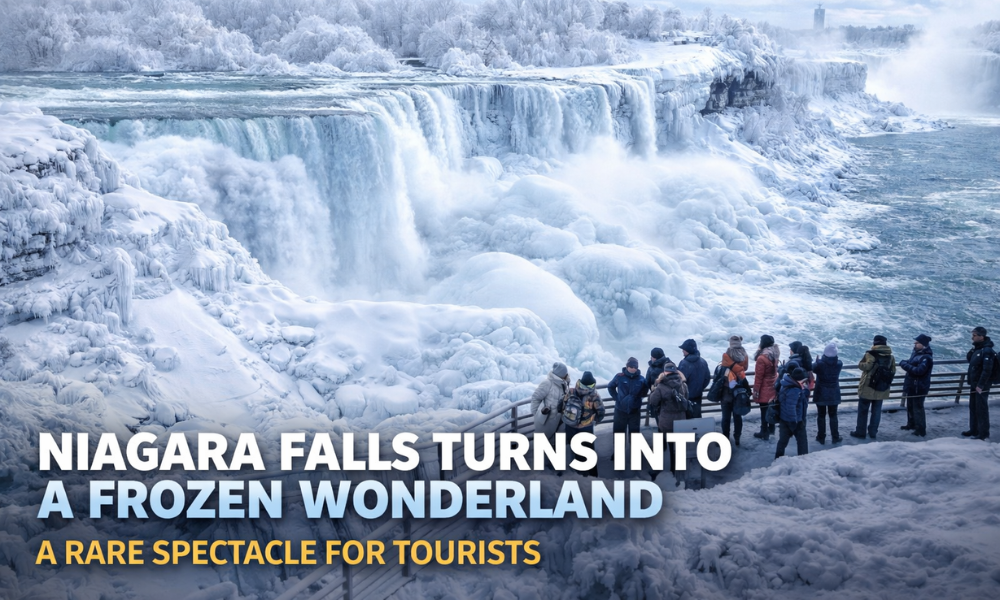
Niagara Falls, one of the most iconic natural wonders of the world, is globally known for its thunderous roar, immense power, and continuous flow of water. Located on the border of the United States and Canada, the falls attract millions of tourists every year who come to witness its dramatic beauty. However, on rare occasions during extreme winter conditions, Niagara Falls presents a completely different face to the world—one that looks straight out of a fantasy. The article shown in the image captures such a moment, when unusually cold weather caused large portions of Niagara Falls to freeze, transforming it into a breathtaking icy landscape and drawing massive crowds of tourists.
During intense winter cold waves, temperatures in the Niagara region can drop far below freezing. When this happens, the mist rising from the cascading water freezes almost instantly upon contact with rocks, railings, trees, and walkways. Over time, thick layers of ice form, creating towering ice sculptures around the falls. While the water itself does not completely stop flowing due to the enormous volume and force, the surface appearance gives the illusion that the falls have frozen solid. This phenomenon is rare and short-lived, which makes it even more special for visitors.
The frozen Niagara Falls becomes a visual spectacle unlike anything seen during other seasons. The roaring white water is replaced by shimmering ice formations, massive icicles, and snow-covered cliffs. The surrounding landscape turns into a frozen wonderland, with shades of white, blue, and silver dominating the view. Sunlight reflecting off the ice creates a magical glow, especially during early mornings and late afternoons. Photographers, nature lovers, and tourists flock to the area to capture these once-in-a-lifetime moments.
According to reports highlighted in the article, the freezing event was triggered by extremely low temperatures and strong winds. In some instances, temperatures dropped well below minus 10 to minus 20 degrees Celsius. Such conditions cause ice to accumulate rapidly, especially near the American Falls and Bridal Veil Falls, where water spreads over a wider surface. Large ice mounds form at the base of the falls, sometimes growing so tall that they partially block the view of the cascading water behind them.
Despite the freezing temperatures, tourist interest does not decline—on the contrary, it often increases. The article notes that thousands of visitors arrived to witness the frozen falls, even braving harsh cold and slippery conditions. Tourists wrapped in heavy jackets, scarves, gloves, and winter boots could be seen taking photographs, shooting videos, and admiring the extraordinary transformation of the natural wonder. For many, seeing Niagara Falls in this frozen state is a dream experience, as it contrasts sharply with the powerful, roaring image most people associate with the falls.
Local authorities, however, remain cautious during such periods. While the frozen scenery is stunning, it also presents safety risks. Icy walkways, freezing winds, and unstable ice formations can be dangerous. In the past, authorities have restricted access to certain viewing areas to prevent accidents. Tourists are advised to follow safety instructions, stay within designated areas, and avoid venturing too close to the edge of the falls or onto ice-covered surfaces.
Historically, Niagara Falls has experienced partial freezing several times, but complete freezing is extremely rare. One of the most famous instances occurred in 1848, when an ice jam temporarily stopped the flow of water for several hours. Since then, technological measures like ice booms have been introduced to manage ice flow and prevent damage to infrastructure such as bridges and hydroelectric power plants. These systems also reduce the likelihood of the falls completely freezing over again.
Beyond tourism, the freezing of Niagara Falls also sparks discussions about climate patterns and extreme weather events. While cold winters have always occurred in the region, sudden and intense temperature drops highlight the unpredictable nature of weather in recent years. Scientists and environmentalists often point out that climate change does not only mean rising temperatures but also includes extreme cold events, shifting weather patterns, and unusual natural phenomena.
For local businesses, the frozen falls can be both a challenge and an opportunity. While some activities may slow down due to harsh weather, hotels, restaurants, and tour operators often see a surge in visitors eager to experience the rare sight. Winter tourism packages, guided tours, and scenic viewpoints become popular during these periods. The frozen falls thus continue to support the local economy, even in the coldest months.
In conclusion, the freezing of Niagara Falls is a powerful reminder of nature’s ability to surprise and transform itself. What is usually a symbol of raw, unstoppable force becomes a quiet, frozen masterpiece, captivating everyone who witnesses it. The article captures not just a weather event, but a moment where nature, climate, and human curiosity intersect. For tourists, it is a rare chance to see a world-famous landmark in an entirely new form. For others, it is a reminder of nature’s unpredictability and beauty. Whether roaring or frozen, Niagara Falls remains one of the most awe-inspiring sights on Earth.