
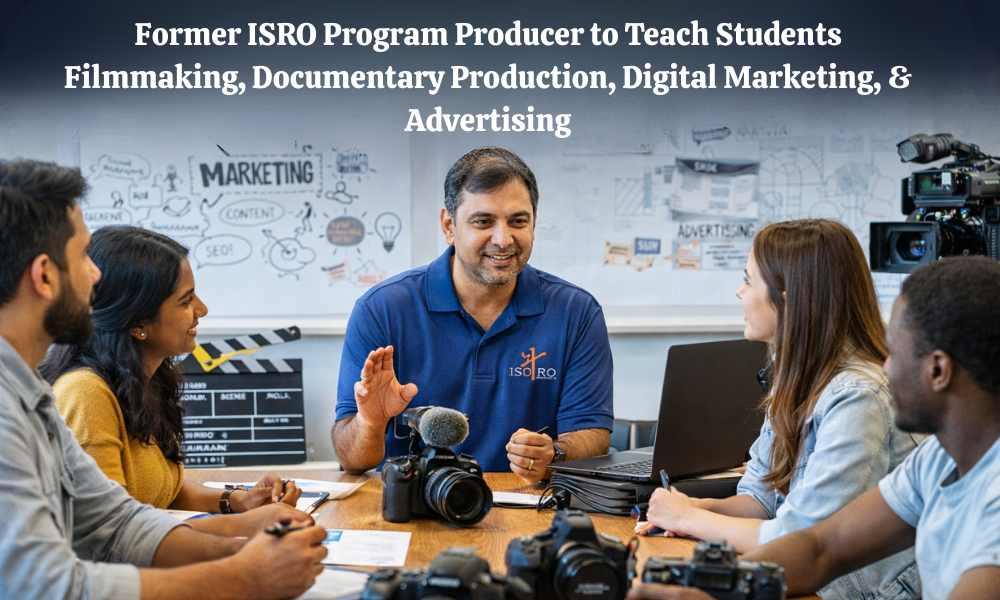
In an era dominated by digital media, visual storytelling, and online communication, skill-based education has become more important than ever. Recognizing this shift, Saurashtra University has announced a unique three-day workshop aimed at equipping students with practical knowledge in filmmaking, documentary production, digital marketing, and advertising. What makes this initiative especially significant is the involvement of a former program producer from ISRO, bringing rare industry and institutional experience directly into the classroom.
The workshop will be held at the university’s journalism and mass communication department and is open to students from various academic backgrounds. Scheduled over three days, the program focuses not only on theory but also on hands-on learning, enabling participants to understand the real-world demands of the media and communication industry. Registration for the workshop has already begun, and interest among students has been steadily growing.
The former ISRO program producer, who played a key role in designing and managing educational and scientific broadcasts, will guide students through the fundamentals of visual communication and storytelling. At ISRO, program producers are responsible for translating complex scientific missions into content that can be understood by the general public. This experience provides invaluable insight into how clarity, accuracy, and creativity can work together to create impactful media.
One of the major highlights of the workshop is filmmaking training. Students will be introduced to the entire filmmaking process, starting from idea development and scriptwriting to shooting and post-production. The sessions will cover camera angles, lighting techniques, framing, and shot composition, helping students understand how visual choices affect storytelling. Rather than focusing solely on expensive equipment, the training emphasizes creativity and planning, proving that powerful stories can be told even with limited resources.
Documentary production is another key component of the workshop. Documentaries play a crucial role in recording reality, preserving history, and addressing social issues. Students will learn how to research topics, conduct interviews, structure narratives, and maintain ethical standards while documenting real-life stories. The trainer’s experience in producing informative and educational content at a national level will help students grasp the responsibility that comes with documentary filmmaking.
In addition to visual storytelling, the workshop places strong emphasis on digital marketing, a field that has rapidly transformed how organizations communicate with audiences. Students will be taught the basics of digital platforms, audience analysis, content strategy, and brand positioning. The sessions will explain how videos, graphics, and written content can be strategically used on social media, websites, and streaming platforms to achieve communication goals.
Advertising and branding form another important segment of the program. Students will learn how advertising messages are conceptualized, designed, and delivered across various media channels. From understanding consumer psychology to creating persuasive campaigns, the workshop aims to provide a practical foundation for those interested in creative and marketing careers. Real-world examples and case studies will be used to demonstrate how successful advertising campaigns are built.
What sets this workshop apart is its professional and practical orientation. Instead of focusing solely on academic concepts, students will be exposed to industry practices such as teamwork, deadlines, client expectations, and content evaluation. The trainer will share personal experiences from working on large-scale projects, offering insights that are rarely found in textbooks.
The workshop is especially relevant for students of journalism, mass communication, media studies, and fine arts. However, it is also open to students from science, engineering, and commerce backgrounds who wish to explore creative communication as a career option or complementary skill. In today’s job market, the ability to communicate ideas visually and digitally is valuable across disciplines.
Faculty members at Saurashtra University believe that such initiatives bridge the gap between academic learning and professional requirements. They emphasize that media education must evolve with changing technologies and audience behavior. By inviting experienced professionals to mentor students, the university aims to enhance employability and encourage innovation among young learners.
Students attending the workshop will also gain an understanding of ethical communication, particularly in the age of misinformation and digital manipulation. Discussions will include responsible content creation, factual accuracy, copyright awareness, and the social impact of media. These lessons are especially important for aspiring filmmakers and marketers who will influence public opinion through their work.
Upon completion of the workshop, participants will receive certificates, adding value to their academic and professional profiles. More importantly, they will leave with practical knowledge, creative confidence, and a clearer understanding of career opportunities in media, digital marketing, and advertising.
In conclusion, the three-day workshop led by a former ISRO program producer represents a forward-thinking step in media education. By combining filmmaking, documentary production, digital marketing, and advertising under one platform, the initiative offers students a holistic learning experience. As digital media continues to shape how information is shared and consumed, such skill-based programs play a crucial role in preparing students for the challenges and opportunities of the modern communication landscape.