
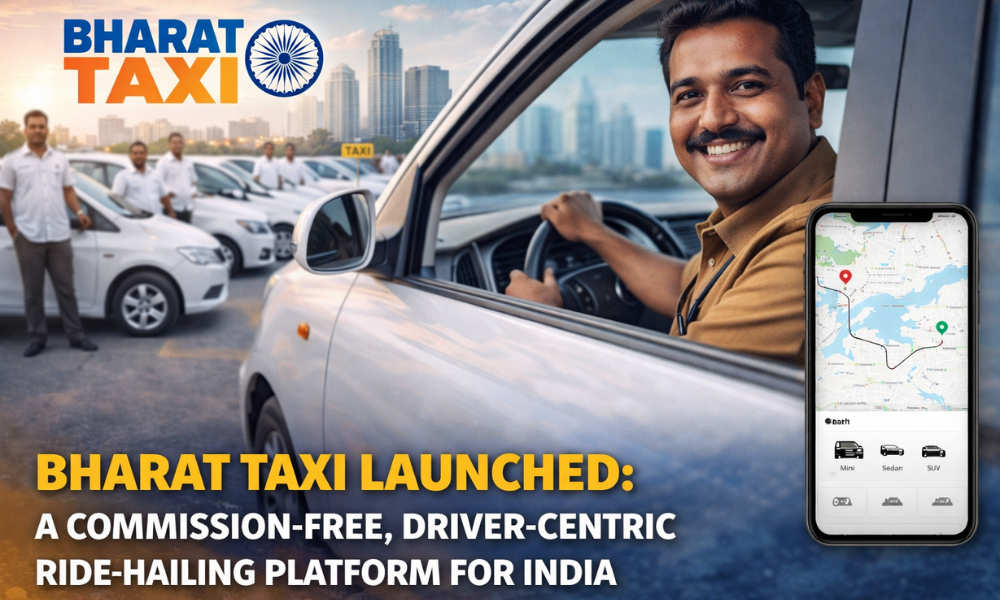
India’s ride-hailing landscape has taken a significant new turn with the launch of Bharat Taxi, a government-supported platform designed to directly benefit drivers while offering affordable and transparent services to passengers. As reported in the Gujarati news article, Bharat Taxi aims to challenge existing private cab aggregators by removing commission charges, surge pricing, and exploitative business practices. The initiative represents a bold attempt to restructure India’s taxi ecosystem with fairness, inclusivity, and economic sustainability at its core.
Bharat Taxi has been introduced as a driver-first platform, where cab drivers are not treated as contractors at the mercy of algorithms, but as partners in a system that prioritizes their income stability and dignity. Unlike popular private ride-hailing apps that charge drivers commissions ranging from 20% to 30% per ride, Bharat Taxi operates on a zero-commission model. This means drivers keep the full fare paid by passengers, significantly increasing their take-home earnings.
One of the most notable aspects of Bharat Taxi is the absence of surge pricing. In existing platforms, fares often increase sharply during peak hours, bad weather, or emergencies, making travel expensive and unpredictable for passengers. Bharat Taxi removes this uncertainty by offering fixed and transparent pricing, ensuring affordability for users and consistency for drivers. This approach is particularly beneficial for daily commuters, elderly passengers, women, and people from lower- and middle-income groups.
The platform has been launched under the guidance of the central government, with the inauguration carried out by Union Home Minister Amit Shah. The initiative aligns with broader government goals of promoting self-reliance, digital inclusion, and equitable economic opportunities. Bharat Taxi is positioned not just as a transport service, but as a public-interest digital infrastructure that counters monopolistic practices in the private sector.
According to the data highlighted in the article, Bharat Taxi has already gained significant traction. Over 4 lakh drivers have joined the platform, and more than 10 lakh users have registered in a relatively short span of time. These numbers reflect widespread interest and trust, especially among drivers who have long expressed dissatisfaction with high commissions, incentive instability, and arbitrary account suspensions on private platforms.
Bharat Taxi supports multiple service categories, including two-wheelers, auto-rickshaws, and four-wheelers, making it a comprehensive mobility solution. Importantly, the platform also places strong emphasis on women’s safety and participation. Special provisions allow women drivers and women passengers to opt for “Saathi Ride” features, enabling safer and more comfortable travel experiences. This focus addresses long-standing safety concerns in urban transport systems.
Another key strength of Bharat Taxi is its simple and driver-friendly digital interface. Many drivers in India come from semi-urban or rural backgrounds and often struggle with complex app-based systems. Bharat Taxi has been designed to be easy to use, reducing technological barriers and enabling wider participation. Additionally, customer support and grievance redressal mechanisms are structured to be more transparent and responsive compared to private aggregators.
From an economic perspective, Bharat Taxi has the potential to reshape income distribution within the gig economy. By eliminating commission cuts, drivers can earn more without increasing fares, creating a rare win-win situation. Stable incomes also reduce drivers’ dependence on long working hours, improving work-life balance and road safety. Over time, this model could set new standards for ethical platform-based employment in India.
Passengers, too, stand to gain significantly. With no surge pricing and lower base fares, Bharat Taxi promises cost-effective travel. The article notes examples of fares for short distances being markedly affordable compared to private competitors. For instance, the minimum fare for the first few kilometers is kept intentionally low to encourage adoption and ensure accessibility for all sections of society.
However, the success of Bharat Taxi will depend on sustained implementation, technological reliability, and effective scaling. Competing with established global players is no small task. Issues such as app performance, real-time availability of vehicles, and consistent service quality will be critical. The government-backed nature of the platform may inspire trust, but long-term success will require continuous innovation and responsiveness to user feedback.
There are also broader social implications. Bharat Taxi challenges the notion that digital platforms must prioritize profit over people. It demonstrates that technology can be used as a tool for empowerment rather than exploitation. If successful, this model could inspire similar initiatives in other sectors of the gig economy, such as food delivery, logistics, and home services.
In conclusion, the launch of Bharat Taxi marks an important moment in India’s urban mobility journey. By removing commissions, eliminating surge pricing, and placing drivers and passengers at the center of its design, the platform offers a more humane alternative to existing ride-hailing services. While challenges remain, Bharat Taxi represents hope for a fairer, more inclusive digital economy—one where growth is shared, not extracted. If nurtured properly, it could redefine how India moves, works, and connects in the years to come.