





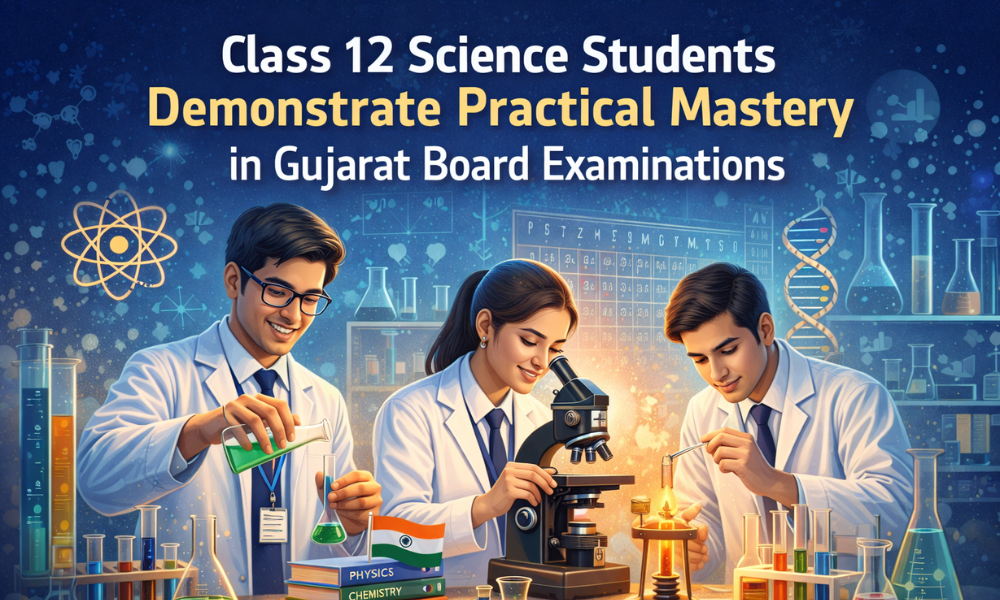
The Gujarat Secondary and Higher Secondary Education Board (GSHSEB) recently conducted the Class 12 Science stream practical examinations across the state, marking an important academic milestone for thousands of students. According to reports, the practical exams began smoothly, with students confidently performing experiments using instruments such as galvanometers, meter bridges, ammeters, voltmeters, and various optics and electronics setups. The examinations reflected not only students’ conceptual understanding but also their hands-on laboratory skills, which are a crucial part of science education.
On the very first day of the practical examinations, a significant number of students appeared across different districts. In Rajkot district alone, more than a thousand students took part in the practical exams at multiple centers. Statewide, the number of candidates running into tens of thousands highlighted the scale and importance of these examinations. The practical exams were organized well ahead of the theory papers, giving students the opportunity to focus on experimental accuracy, observation, and viva-voce performance without the immediate pressure of written exams.
The Class 12 Science practical examinations are designed to test students on a wide range of experiments from physics, chemistry, and biology. In physics, students were required to perform experiments involving galvanometers, meter bridges, resistance calculations, and the use of electrical measuring instruments such as ammeters and voltmeters. Optics experiments, including those related to refraction, focal length determination, and ray diagrams, were also part of the assessment. These experiments demand precision, careful observation, and a clear understanding of underlying scientific principles.
One of the notable aspects reported was the confident manner in which students handled laboratory instruments. Many students demonstrated familiarity with setting up circuits, adjusting equipment, taking accurate readings, and recording observations systematically. This confidence suggests that schools have been emphasizing regular laboratory practice throughout the academic year, rather than treating practical work as a last-minute requirement. Teachers and examiners noted that students were generally well-prepared and capable of explaining the theory behind the experiments during the oral examination.
Chemistry practicals focused on qualitative and quantitative analysis, titration methods, salt analysis, and identification of organic compounds. Students were assessed on their ability to follow proper laboratory procedures, maintain safety standards, and interpret results correctly. Accurate use of burettes, pipettes, and indicators was essential, as even minor errors could affect final readings. Biology practicals, on the other hand, tested students’ skills in microscopy, slide preparation, identification of specimens, and interpretation of biological processes.
The Gujarat Board ensured that the examinations were conducted under strict supervision and standardized guidelines. Practical exam centers were equipped with necessary instruments and chemicals, and examiners were appointed according to board norms. Clear instructions were given to maintain uniformity in evaluation so that students across different centers were assessed fairly. The board’s efforts to streamline the process helped avoid confusion and ensured a smooth examination experience.
An important feature of these practical exams is their role in building scientific temperament. Unlike theory papers, practical examinations require students to apply what they have learned in real situations. They must troubleshoot problems, make adjustments, and think critically when results do not match expectations. This process nurtures analytical thinking, patience, and problem-solving skills—qualities that are essential for higher education and careers in science, engineering, medicine, and technology.
The article also highlights that the practical examinations included internal assessment components. Marks awarded by subject teachers throughout the academic year, based on laboratory work and periodic evaluations, contribute to the final practical score. This system encourages consistent effort rather than one-time performance. Students who regularly participated in lab sessions and maintained proper practical records benefited from this approach.
Another noteworthy point was the implementation of certain new or reinforced rules during the examination process. To maintain transparency and discipline, students were required to strictly follow time limits, laboratory safety norms, and examiner instructions. Any form of malpractice or negligence could lead to penalties. These measures aimed to uphold the credibility of the examination system and ensure that merit remained the primary criterion for evaluation.
Teachers played a crucial role in preparing students for these practical exams. Many educators guided students through repeated practice sessions, mock practicals, and viva-voce rehearsals. Such preparation helped reduce exam anxiety and allowed students to perform experiments with confidence. Teachers also emphasized the importance of clear presentation—neat diagrams, properly labeled tables, and logical explanations during oral questioning.
From the students’ perspective, the practical examinations were both challenging and rewarding. While some experiments required careful handling and precise calculations, students generally felt satisfied after successfully completing their tasks. For many, the practical exams provided a welcome break from rote memorization and allowed them to showcase their true understanding of science. Several students expressed that performing experiments made scientific concepts more meaningful and easier to remember.
The smooth conduct of the Class 12 Science practical exams reflects positively on the overall state of science education in Gujarat. Adequate infrastructure, trained teachers, and a structured evaluation system have contributed to a productive examination environment. As education increasingly emphasizes experiential learning, such practical assessments become even more significant.
In conclusion, the Class 12 Science practical examinations conducted by the Gujarat Board demonstrated students’ growing competence in laboratory work and experimental science. The confident use of instruments like galvanometers and meter bridges, along with accurate observations and explanations, showed that students are not just learning science from textbooks but are also engaging with it practically. These examinations serve as a strong foundation for students’ future academic and professional journeys, reinforcing the idea that true scientific understanding comes from both theory and practice.