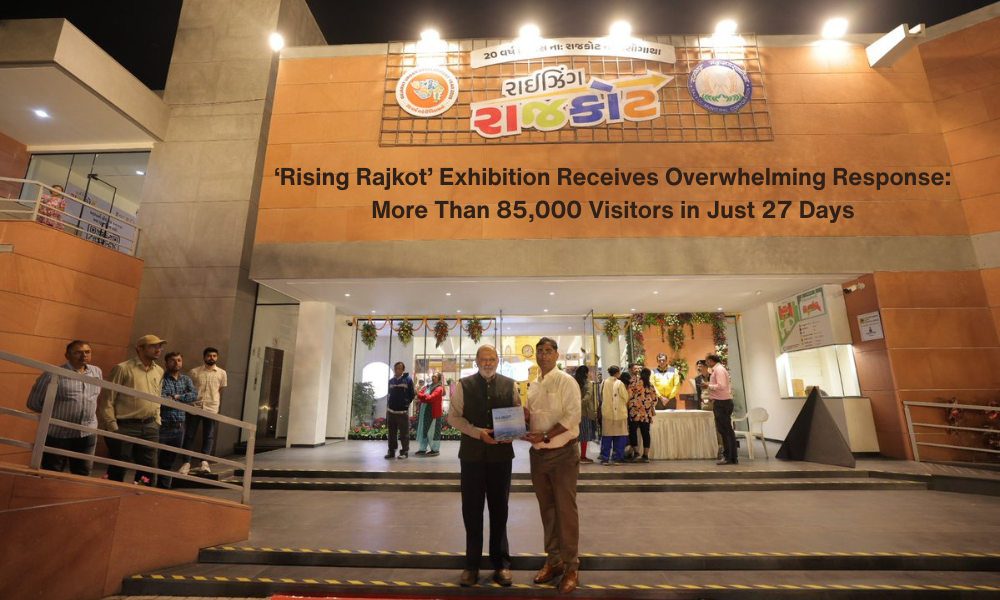
Rajkot has long been known as one of Gujarat’s most progressive cities, combining strong industrial growth with rich cultural heritage. Adding another proud chapter to its journey of development, the ‘Rising Rajkot’ Exhibition, organized by the Rajkot Municipal Corporation (RMC), received an exceptional public response. Held over a period of 27 days, the exhibition attracted more than 85,000 visitors, reflecting the city’s growing interest in planned urban development, innovation, and civic awareness.
The ‘Rising Rajkot’ exhibition was conceived as a platform to showcase the city’s transformation over the years and present a clear vision for its future. Rather than being a conventional display, the exhibition offered an immersive experience that connected citizens with Rajkot’s past achievements, present infrastructure, and ambitious future plans. From students and professionals to senior citizens and business owners, people from all walks of life visited the exhibition, making it one of the most successful civic initiatives undertaken by the municipal corporation.
At the heart of the exhibition was the idea of inclusive development. The Rajkot Municipal Corporation aimed not only to inform citizens about ongoing and upcoming projects but also to make them feel like active participants in the city’s growth story. Through visually engaging models, digital presentations, and interactive panels, complex urban planning concepts were simplified and presented in an easy-to-understand manner.
One of the key attractions of the ‘Rising Rajkot’ exhibition was its detailed presentation of the city’s infrastructure development. Visitors were given insights into road expansion projects, flyovers, underpasses, drainage systems, water supply improvements, and traffic management plans. Three-dimensional models and animated videos helped people visualize how these projects would ease daily commuting and enhance the overall quality of life in Rajkot. The clarity and transparency with which these projects were presented earned widespread appreciation from the public.
The exhibition also placed strong emphasis on Rajkot’s journey toward becoming a Smart City. Dedicated sections highlighted smart governance initiatives, digital public services, surveillance systems, and technology-driven solutions for urban challenges. Information about online civic services, mobile applications, digital payments, and grievance redressed platforms was shared, enabling citizens especially senior residents and small business owners to better understand and adopt digital tools in their daily lives.
Environmental sustainability formed another important pillar of the exhibition. With growing concerns about climate change and urban pollution, the Rajkot Municipal Corporation showcased its initiatives related to solid waste management, recycling, green energy, solar power, and water conservation. Visitors learned about waste segregation at source, composting, and the use of renewable energy in public infrastructure. These displays reinforced the message that sustainable development is a shared responsibility between the government and citizens.
A unique feature of the ‘Rising Rajkot’ exhibition was its focus on education and youth engagement. Special efforts were made to invite school and college students, helping them understand urban development, civic responsibility, and the role of technology in city planning. Educational tours, guided explanations, and interactive displays ensured that young minds not only gained knowledge but also developed a sense of pride and responsibility toward their city. For many students, the exhibition served as an eye-opening experience, inspiring interest in urban planning, engineering, environmental science, and public administration.
The exhibition also highlighted Rajkot’s cultural and historical evolution. Old photographs, maps, and archival records depicted the city’s transformation from a traditional town into a modern urban center. This blend of heritage and progress resonated deeply with visitors, reminding them that development does not mean losing identity but strengthening it through thoughtful planning.
Another factor behind the exhibition’s success was the presence of trained volunteers and guides who assisted visitors throughout their journey. These guides explained each section in simple language, answered questions patiently, and ensured that visitors fully understood the displayed information. Their efforts transformed the exhibition into an interactive learning space rather than a passive viewing experience.
The overwhelming response with more than 85,000 visitors in just 27 days prompted discussions about extending the exhibition’s duration and replicating similar initiatives in the future. The turnout clearly demonstrated that citizens are eager to learn about governance, infrastructure, and development when information is presented transparently and creatively.
Beyond numbers, the real success of the ‘Rising Rajkot’ exhibition lies in the awareness and dialogue it generated. It conveyed a powerful message: urban development is not solely the responsibility of municipal authorities but a collective effort that requires active citizen participation. Maintaining cleanliness, following traffic rules, conserving resources, embracing digital services, and engaging constructively with civic bodies are all essential components of a truly smart city.
In conclusion, the ‘Rising Rajkot’ exhibition stands as a landmark initiative that successfully bridged the gap between governance and citizens. By attracting massive public participation and fostering civic pride, it reinforced Rajkot’s image as a forward-thinking city committed to sustainable and inclusive growth. As Rajkot continues to evolve, initiatives like ‘Rising Rajkot’ will undoubtedly play a crucial role in shaping an informed, responsible, and engaged urban community one that is ready to build a brighter and smarter future together.